
OUTLIERS FROM EAST AND WEST
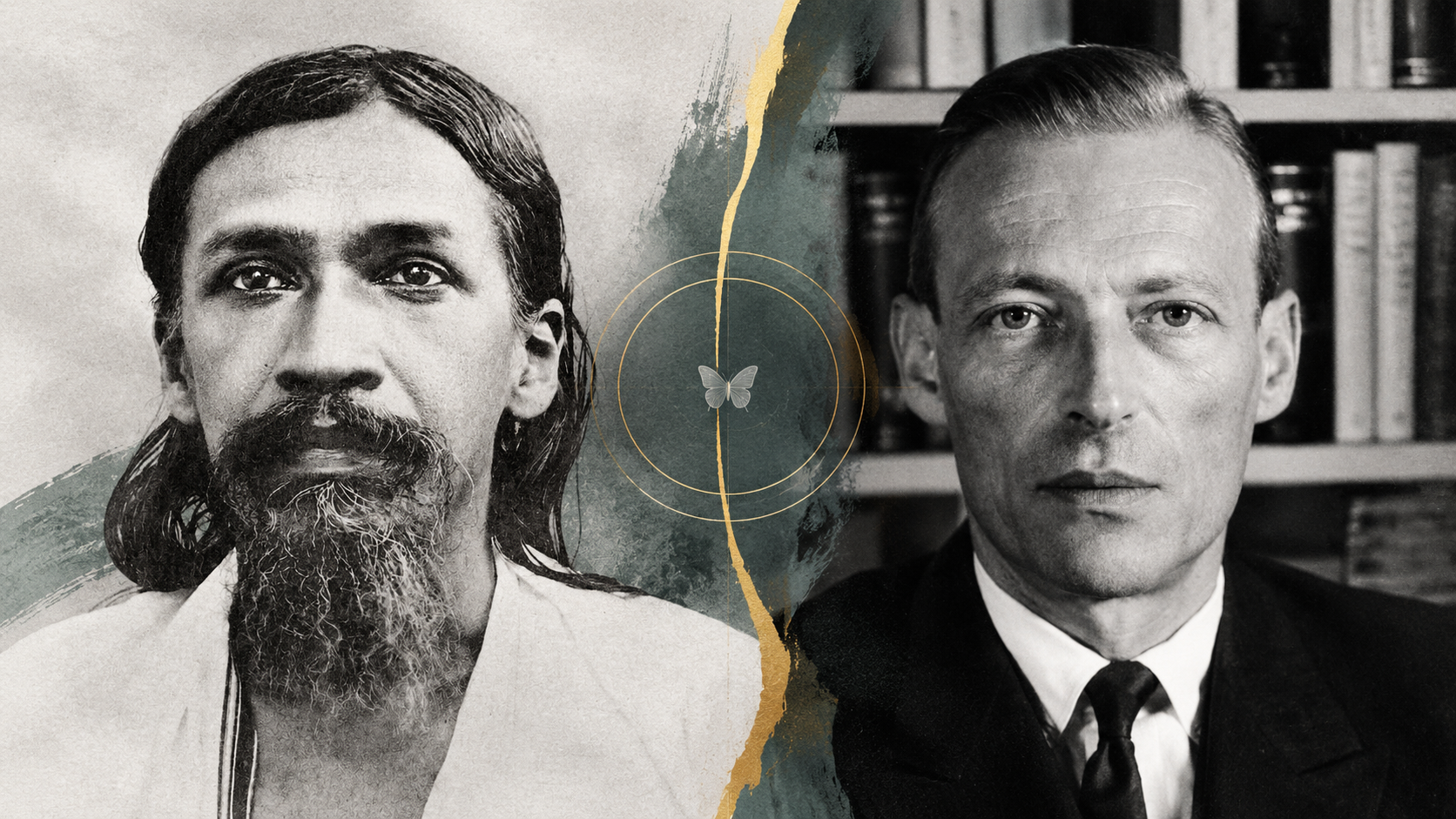
Sri Aurobindo and Jean Gebser
by steve brett
These two philosophers, if we can exactly call them that, Jean Gebser and Sri Aurobindo, are rarely considered together. This is understandable to an extent, as they were from different generations and lived in completely different parts of the world. Their background and style of presentation are indicative of this. But this can disguise how much at the deepest level of their thought and objective, they share.
Incidentally, Jean Gebser was very aware of Sri Aurobindo, and refers to him in his major work, The Ever-Present Origin, as someone who shared his own human-universal orientation, and his conception of a newly emergent consciousness.
This essay is a short exploration of their thinking. I hope, therefore, readers will forgive what is undoubtedly a great over-simplification of the scope of the work of these two brilliant thinkers. I think the exercise is still worth it, even if only to introduce those unfamiliar with them to some of the perspectives they shared, and the implications of their insights for the world we find ourselves in today—which are profound.
Jean Gebser, the phenomenologist, poet, and philosopher, born in Prussia 1905, was forced by historical circumstances and the priority of his work, to spend much of his adult life traveling, living and writing in different parts of Europe, and visiting India and the Far East. He is known for his extraordinarily innovative and comprehensive exposition on the entire spectrum of human evolution, through the lens of consciousness. And through that lens, producing a breathtaking analysis of the crisis and challenge of our modern age.
Sri Aurobindo, the Indian revolutionary, mystic, and yogi, was born in what is now Kolkata in Bengal, India in 1872. He was educated at Cambridge in the UK, returned to India to become a leader in the Indian nationalist movement, was imprisoned by the English for his revolutionary activities, and later fled from English authorities to the French colony of Pondicherry in South India. It was here that he took on the life of a mystic and yogi/philosopher—writing a large number of significant works, in which he articulated his spiritual philosophy and path, ‘Integral Yoga’.
Both Jean Gebser and Sri Aurobindo would certainly be considered ‘outliers’ of mainstream philosophical thought. Yet they were both living and writing through the same tumultuous period of world history, in which long accepted ideas were being turned upside down in the wake of two World Wars and enormous technological, scientific and psychological breakthroughs. Their insights belong very much to that experimental era, although they are arguably ever more relevant today.
Jean Gebser’s magnum opus, The Ever-Present Origin, written in 1949, is a phenomenological account of the journey of human consciousness from humanity’s origins to the present, through a series of five epochs, or what he calls ‘structures’ of consciousness, which he terms the archaic, the magical, the mythical, the mental-rational, and the integral.
The new thinking that was burgeoning in Europe at the time of Gebser’s writing in the mid-20th century, from philosophy (Nietzsche and Bergson), to physics (Einstein), and psychology (Freud and Jung), undoubtedly contributed to the extraordinarily wide-ranging and multifaceted way in which Gebser was able to approach his subject.
To take one example, rather than perceiving these structures of consciousness he was delineating, as taking place in a linear progression, he called them “mutations”. That is, he saw them not as a continuum but as occurring in ‘leaps’, that were by their nature, spontaneous and indeterminant. And he doesn’t see these mutations as biological or historical, but “spiritual”—meaning that each mutation unfolds towards a further “structural enrichment” and “intensification” of consciousness.
According to Gebser, unlike biological mutations, these structures, such as the magic and the mythical for example, do not disappear when new ones come into being but remain latent in the new structure in the human psyche. Therefore, the past is still present in ways that continue to influence our experience and behaviour. And the future remains hidden and latent within the present.
EVOLUTION AND INVOLUTION
Gebser and Aurobindo both lived through the extended wake of Darwin’s theory of evolution—the most widely acclaimed scientific theory of the nineteenth century. While they would certainly have acknowledged Darwin’s achievement, they were also critical of its materialistic bias, and in their lifework began reappraising its conception entirely through a consciousness or ‘spiritual’ lens.
Aurobindo himself, using as his reference the ancient Indian texts of the Upanishads and the Vedas, which he was reading at the time in the original Sanskrit, as well as his own mystical experience, considered there must be an evolution from something. He argued that Darwin’s theory of evolution provided no clear origin, or any answer as to why it began in the first place.
“What is meant by evolution”, he asked, “what is it that evolves, from what and by what force of necessity? The word evolution carries with it in its intrinsic sense…the necessity of a previous involution. The spiritual process of evolution is then…not a making of what never was, but a bringing out of what was implicit in the Being.”
Concealment and revelation, enfolding and unfolding. To Aurobindo, nothing can evolve that is not previously involved.
As he wrote in his master work The Life Divine, “The Infinite is contained in the Finite as the tree and all its branches are contained in the seed…Nothing can evolve out of Matter which is not therein already contained.”
Gebser agreed, considering his own series of mutations in consciousness as already existing as potential, concealed in a latent invisible state and unfolding from an ever-present whole, which he refers to as the ‘Ever-Present Origin’.
A CRITICAL MOMENT IN HUMAN EVOLUTION
At the time of their writing in the early to mid-20th century, the wars in Europe had thrown the world into very dark times, bringing into question the conviction in human progress that had driven Western civilisation and the scientific revolution since the seventeenth century. For Gebser and Aurobindo this was a critical moment in human evolution.
From his own Indian perspective, Aurobindo thought that the Age of Reason and the birth of individualism in the West, from its apex in the vibrancy of the Renaissance in Europe, had been a spirit-saving corollary to an age of conformity to religious and social traditions, which he considered his own country had been lost in for two thousand years.
He wrote, “…It is to its passion for the discovery of the actual truth of things and for the governing of human life by whatever law of the truth it has found that the West owes its centuries of strength, vigour, light, progress, irresistible expansion…And it is necessarily individualistic.”
For the West, ‘the law of truth’ that now stood at the centre of existence, was no longer the word of God and religious scripture, but that of science and the scientific revolution.
To Aurobindo, the attempt to organise human life and society on the basis of scientific and rational truth, was certainly the crowning achievement of the individualistic age. And yet, despite the obvious triumphant domination of science, Aurobindo thought the laws of scientific rationalism themselves, seemed to be suppressing the very individualism which had given rise to their discovery.
This insight echoed Jean Gebser’s own perception of what he was calling in his own work, the “deficient” stage of the mental-rational or perspectival consciousness. In its full splendour during the Renaissance, Geber saw the mental consciousness as an extraordinarily enriching mutation out of the mythical age. For it gave birth to the ability of human beings to stand back from the world and see it in perspective, in a subject/object duality. Although the discovery of space and perspective was a shocking revelation at first, it was this objective consciousness out of which the age of discovery in Europe, flowered.
Nevertheless, for Gebser, by the time of his writing in 1949, the mental-rational perspectival consciousness was now well into its declining and degraded state, which as he wrote, “manifests on one hand in an egocentric individualism exaggerated to extremes and desirous of possessing everything, and on the other…an equally extreme collectivism…the utter abnegation of the individual valued merely as an object in the human aggregate.”
Sri Aurobindo’s own thinking was travelling on similar lines between 1917 and the late 1930’s. He thought that the European passion for discovery had become hardened toward an exclusive emphasis on objectivity and scientism, which was leading the world down a dangerous cul-de-sac.
On the one hand, it was manifesting in a strict ordering of society by the State, through Fascism in Germany and Communism in Russia, in which individuality had no place. On the other hand, it was manifesting in an egocentric individualism, entirely divorced from a connection or concern for life as a whole. This was when Frederick Nietzsche made his famous outburst on “the death of God”.
In the wake of the deployment of the atomic bomb in Hiroshima, Gebser commented, “We must soberly face the fact that only a few decades separate us from [a global catastrophe]. This span of time is determined by an increase in technological feasibility inversely proportional to man’s sense of responsibility.”
Standing back for a moment and looking at this ‘crisis of consciousness’ through the deep-time lens of Gebser’s own schema, we find a clarifying insight. With humanity’s gradual differentiation out of what Sri Aurobindo terms the “inconscient” and Gebser the archaic structure of consciousness—that is a one-dimensional inseparability from existence—to the three-dimensional, now entirely separate sense of the individual self, an increasing remoteness from ‘origin’ had taken place. By origin, here, Gebser means the “ever-present’ origin” of all the structures of consciousness—the “ever-originating”, living, undivided presence of past, present and future. Or, as Sri Aurobindo and all Vedic and Upanishadic thought referred to it: Sat-Chit-Ananda, Being-Consciousness-Bliss, the ever-present timeless source of all existence.
FROM SUBJECTIVITY TO INTEGRAL AND THE SUPRAMENTAL
“Where there is peril, deliverance too gains in strength”—Hölderlin
Despite the fear of an impending catastrophe, Jean Gebser and Sri Aurobindo were acutely aware that right in the midst of the cauldron of this existential crisis in the mid-20th century, a new form of consciousness was breaking through.
Writing in 1916 in his work, The Human Cycle, originally called The Psychology of Human Development, while the age of reason was in decline, from Aurobindo’s perspective a new ‘subjective’ age was beginning to manifest in human culture. The subjective was significant for Aurobindo because it had spiritual meaning. For Aurobindo it was a spark of the true self, or ‘concealed’ ultimate reality – “an ever-increasing self-recognition, self-realisation and a resultant self-shaping.”
He wrote: “There is a deeper truth which individualism has discovered that the individual is not merely a social unit; his existence, his right and claim to live and grow are not founded solely on his social work and function…He is something in himself, a soul, a being, who has to fulfil his own individual truth and law as well as his natural or his assigned path in the truth and law of the collective existence.”
It wasn’t lost on Aurobindo, however, that the birth of subjectivity, as critical a step as it was, was fraught with danger. There is a false and a true subjectivism he argued, the false ruled by individual egoism, and the true subjectivism, which knows the ego is not the self but only a portion of the universal—in which “we are not only ourselves, but all others”. A brilliant and critical distinction.
Aurobindo saw this true subjectivity appearing in art, music, literature and philosophy, as well as interestingly, in the education of children. Here, the individual and the community were supporting each other, not as separate entities, but as “the same impulse of the one common existence, companion movements separating only to return upon each other in a richer and larger unity and mutual consequence.”
For Aurobindo the awakening of the subjective was potentially the first step toward what could become a “supra-rational” or spiritual age. He wrote:
“Man’s road to spiritual supermanhood will be open when he boldly declares that all he has yet developed, including the intellect of which he is so rightly and yet so vainly proud, are now no longer sufficient for him, and that to uncase, discover, set free this greater Light within shall be henceforward his pervading occupation. Then will his philosophy, art, science, ethics, social existence, vital pursuits, be no longer an exercise of life and mind, done for themselves, carried in a circle, but the means for a discovery of a greater Truth behind mind and life, and for the bringing of its power into human existence.”
What is striking about Aurobindo’s philosophy is how contrary it is to how Indian philosophy is often characterised, as seeing the world as illusory (Maya), and spiritual liberation about the transcendence of the world. For Aurobindo, drawing from the Upanishads and his own inner revelation, matter and spirit were never a contradiction. The path of awakening was about transforming the world: a collective awakening, enabling humanity to bring Sat-Chit-Ananda, the ultimate nature of existence, down into the world to transform it, through what he called “The Supramental.” This is the essence of Sri Aurobindo’s Integral Yoga.
Jean Gebser was also keenly aware that a new consciousness mutation was emerging in human culture. He characterised this mutation as an ‘aperspectival’ consciousness. He explained this did not mean the opposite of the preceding ‘perspectival’ consciousness, but rather it was a consciousness that was not restricted to any one perspective or another.
He also referred to this new consciousness as an ‘integral’ consciousness. This had a more complex meaning for Gebser than for Aurobindo. For the integral consciousness to truly come into being in the human, it would mean the irruption of our experience of time into what he referred to as the ‘achronon’ or ‘time freedom’.
“This freedom from time”, Aaron Cheak, a former head of the Gebser Society explains, “while ever-present and foundational, only emerges into consciousness when the individual forms of time [i.e. the previous structures of consciousness] have been unfolded, integrated, and cultivated into a living, breathing, sentient whole. [What Gebser calls] the achronon, therefore, is not attained by abandoning the previous time-forms as if they were inferior stages of a developmental process, but by concretising them, i.e., allowing them to crescend together. Only by “granting to magic timelessness, mythical temporicity, and mental-conceptual time their integral efficacy”, will the “original præternity”, [the ever-present origin] be open to us.”
Having articulated the nature of this new consciousness and stressing the urgency for it to be brought fully into manifestation, a large part of the remainder of Gebser’s The Ever-Present Origin, is given over to documenting how the undercurrent of this new consciousness mutation was breaking through, both in the natural sciences—physics, mathematics, and biology; the social sciences, such as sociology and economics; and in the arts, in literature, music and philosophy.
Gebser and Aurobindo use the word integral to point toward a consciousness of the whole, which is where both their philosophies meet at their core. The meaning of ‘whole or ‘wholistic’, has been somewhat trivialised by the so-called New Age, with its synonym: ‘holistic’. I think Georg Feuerestein is right in saying that Gebser, “…would have distanced himself from this ideology, because he would have recognized in it the workings of the rational consciousness attempting to constellate itself under the influence of the mythical structure of consciousness.”
For Gebser, the word wholistic, or the whole, points to a spiritual transformation beyond the duality of self and other, self and world—a consciousness that is all inclusive. This involves the integration of every part of human existence, including the past, present and future as a living integrum.
He writes: “If our consciousness, that is, the individual persons’ awareness, vigilance and clarity of vision, cannot master the new reality and make possible its realisation, then the prophets of doom will have been correct. Other alternatives are an illusion; consequently, great demands are placed on us, and each one of us have been given a grave responsibility, not merely to survey but to actually traverse the path opening before us.”
CONSIDERATIONS OF THE PRESENT
It is now approaching 100 years since Aurobindo first documented his observation of an emerging subjectivity in the early 20th century, and Gebser began to track the new integral consciousness in different fields of human endeavour.
So, where are we now?
Regarding Aurobindo’s distinction between the true and the false form of subjectivity, there is overwhelming evidence of the central role the true form of the subjective has played—that is, the self-actualising human being as a creative, critical person. From its emergence in the early 20th century, to its ascendance in the 1960’s with civil rights, humanistic psychology, the awakening to patriarchy and the rise of feminism, to its continuing centrality to these and so many other fields today.
Concurrently however, to an alarming extent, the potential of subjectivity—the beingness of being human—has been appropriated by the market forces of capitalism, incentivised by digital technology, and a political world of competing ideologies that feed on subjective sense-making for its own ends. Human beings are constantly being propelled away from authentic selfhood, toward the false subjectivity of the hyper-individualist ego, conformity and nihilism.
As for the mental-rational consciousness, it now seems barely rational at all. For the most part it is ego on steroids. The best of Western norms are being sacrificed to a powerful nexus of the billionaire class, autocrats and multinational power, which fervently strives to protect and advance its dominion. It does so through any leverage it can utilise, and at any cost. Through manipulation of the media, the distortion of the justice system; the denial of the climate crisis and potential ecological collapse, the genocide in the Middle East; as well as its support of the profound inequities of an economic system that keeps the rich in ascendance, and the poor trapped in a fantasy of one day cashing in on the ‘so-called’ good life.
We have buried ourselves within systems and structures that we seem unable and/or unwilling to control or contain. The lack of regulation on AI being the most obvious and frightening current example. This is runaway mental-rational consciousness at the height of its moral descent.
Yet, despite civilisational collapse being an ever more likely reality, there is another reality developing in culture that can easily be overlooked, in the shocks of the daily news cycle. The early manifestations of the consciousness mutation Gebser witnessed in 1949, are now far more developed, not only in the fields he described, but in others that he didn’t or couldn’t have conceived of at the time.
For when a mutation finds its way into human life, the genie is out of the bottle, so to speak. It starts to appear everywhere—since consciousness is not localised.
The climate and ecological crisis alone have been responsible for awakening, especially the young, to the interdependent nature of life. This includes both our desecration of the natural world for generations, and our responsibility for its future. It is forcing us to realise that past industrial actions and future consequences are completely alive right now.
Our relationship to time and space has also changed beyond recognition. Instant communication and digital networks mean that events across the planet happen all at once. Space has collapsed in this sense, in which past, present and future are ever-present in our experience. We increasingly look at the world through multi-perspectival lenses that reflects an ever-complexifying world. Fixed binaries of race and gender are being challenged and upended. Diverse cultures and languages are intermingling more than ever—giving birth to richer and more flexible ways of perceiving and understanding the world.
It does seem like a small but growing minority are in what seems like a David-and-Goliath-like struggle to bring into being an entirely different relationship to the world. This is inspiring radically new cultural forms in which subjectivity and objectivity are no longer a simple binary, but are meeting in a new ontology of the whole.
A CONSCIOUSNESS OF THE WHOLE
Towards the end of “The Ever-Present Origin” Jean Gebser writes, “the genuine work which we must achieve, is that which is most difficult and painful: the work on ourselves.”
This line has often struck me. For however much we might like to believe the new integral consciousness is solidifying in culture, because this is a spiritual consciousness, as Gebser is at pains to point out, its full manifestation is dependent on our willingness to traverse the path ourselves.
So, what does this mean? And what does it involve?
When we begin to become aware that we are not separate from the whole, the significance of our agency enters a different dimension from that of the mental-rational consciousness. When we recognise ourselves as inseparable from the whole, we understand we are responsible for the whole. We begin to become acutely aware and sensitive to the delicate interplay in the living, shared inter-beingness of the world, including the presence of the past, present and future, and the reality that we affect the whole in everything we say and do, from the gross to the subtle.
This realisation that we are not separate from the whole, is a leap in consciousness that inspires a trust in life and existence itself. This might seem hard to come by in the chaotic and frightening times we live in, and yet perhaps not. Gebser makes the interesting point that in the transition between the ending of one structure of consciousness and the emergence of another, the transparency or diaphaneity of our existence in which we are able to see through the world and its three-dimensional solidity, can become more apparent.
One thing is for sure: in our current epoch, we no longer live in a world in which the spiritual life can easily be separated from the material; even if in reality such a separation was never the case.
Aurobindo’s integral yoga draws deeply on the most ancient of India’s philosophical tradition, the Upanishads and the Vedas, which never saw a dichotomy between the material and the spiritual. In that period, they seemed to have stepped out of time altogether, in their extraordinarily sophisticated comprehension of what is involved in living a non-dual life—a life of the whole.
The significance of the Indian concept of dharma for example, is precisely concerned with how to live and act in accordance with the cosmic whole, from which the individual is always inherently inseparable. “This [dharma] is exceedingly subtle,” writes the Indian philosopher, Chaturvedi Badrinath, “full of complexities and ambiguities”, for the very reason that the human world and human relationships are as complex as they are, and in a constant state of flux.
Once we are connected to the whole, meaning and purpose is restored to human life. And this is also perhaps the only place we can find the strength, vulnerability and the love, to bear what is presently happening to our world. It’s also where we find our swadharma (another extraordinarily relevant concept from ancient India)—that is, our own natural place in the order of things, what we are uniquely here to do. This recognition marries our own human subjectivity—the unique human being—with their true context—the all-transcending whole.
What is so valuable and refreshing about Jean Gebser’s work is that it brings the spiritual into the contemporary world at a defining moment, and in a way that we in the West can understand and incorporate on our own terms.
We can think of Jean Gebser in his call to an integral consciousness, as leaning toward the ancient East, and Sri Aurobindo with his celebration of the subjective, as leaning toward the modern West. They both had their eyes on the whole. Already a sign at their time of their writing, of the coming forth of the new consciousness.
This article was originally published on 3rd Space
Steve Brett is the co-founder of 3rd Space and Executive Director of Emergence Foundation, a London-based charity supporting diverse, creatively emergent projects in the UK and Europe. Travelling through Asia and later living and working in India for seven years shaped lifelong values, and a passion for human and cultural transformation.